
Michelle Sindha Thomas
IN THE BEGINNING | KERALA 1900-1955
I: K.C. CHACKO
Equinox closed early today and I’m showering at home. Since my usual toiletries are in my gym locker, I’ve pulled some coconut milk shampoo out from where it has been possibly fermenting under the sink, left behind by a long-gone houseguest. I’ve selected the Latest Hip Hop Malayalam Spotify playlist as the room fills with steam. A song called Virachirith vibrates with a beat so deep with earth and heart and goes on for 14 minutes and I am soon steeping in memory and epiphany as the most vivid imagery fleets across my eyes, all the scattered files, all the nagging poetic loose ends pinning themselves to the investigation board in my mind and resolving the open cases all at once. I don’t know what “Virachirith” means, I don’t know the artist Efy, but I can almost gulp the rhythm and the lilt of spoken Malayalam; the words I can grasp here and there are sliding across my face and inside my mouth and filling the tub, filling the room, buoying me off the floor.
I have been notified in communications micro (So when you had braces, was it in this country?) to macro that the US is not mine though we know noplace else. Since I don’t love it enough to argue, I have over the years very confidently claimed the airport as mine as soon as we exit the taxi for the International Departures gate trailing our beribboned suitcases, and on layovers all along the journey to India I get closer to what it mine: Paris is mine because I disappear into the Algerian haze of it, because of fashion which makes me happier than anything else and so it belongs to me, because of the ballet I studied (to no avail), and the five years of French I learned at Thomas Edison School for Intellectually Gifted and Talented Children; Doha is mine because we are getting closer, hot hot hot and golden brown all around, and then we land in Kochi; Kochi is almost mine but the slang has a grit that intimidates me as we are tender and paavum and straightforward to our own detriment, almost incapable of guile, but when we go to visit Vinodmama in Puthupally, my emotions are spilling everywhere, usually inexplicably, but now in the shower, I understand, in the coconut scented heat and the heartbeat of this tune, this tune that is also mine; I am generally emotional like Vinny, indisputably our most chaotic relative, but I am specifically emotional about Kottayam because Kottayam is fully, completely, inarguably MINE. My mother’s, my father’s, my Uncle Vinny’s, my grandmothers’, my great-grandfathers’, and on and on and beyond. This land is, at last, my land.
*
Once upon a time in Puthuppally, a hamlet in the district of Kottayam, of breezy hills, humid valleys, paddy fields, palms, and rubber trees as far as the eye can see, there lived our great-grandfather Kazhakkel Cherian Chacko—long and lanky, fair-skinned and mild-mannered, a sensitive man, an armchair philosopher, and a veritable lad of leisure. His family members included the illustrious and industrious of Kottayam, their landholdings so extensive that the property of one relative alone now comprises the Rubber Research Institute of India. They donated land, funds and efforts towards the development of schools and hospitals, advocating for the rights of women and the poor, one cousin so zealous he traveled to Calcutta and as far as Jerusalem in pursuit of his theological studies, later becoming the Jacobite bishop of Kottayam. K.C. Chacko was content with a more domestic way of life. He lived a stone’s throw from his grandfather Cherian, his brother Kariakutty, the widow and children of his brother Avarachan, and his two spinster sisters who lived together on the hill, Annamma and Aleyamma. He minded his ancestral lands, caring for generations of workers who had been with the family since before his grandfather’s time, treating them with such fraternity that, given an opportunity to pursue fortune abroad, Mathai the patriarch refused to leave, piercing his ears as a gesture of loyalty—his grandson Joey and his great-grandchildren still live in Puthupully today.
K.C. Chacko suffered a great personal loss: Chirakuzhiyil Mariamma, the wife of his youth, had died. Her family, wealthy landlords of nearby Mundakapadum, helped him raise his three small children, Aleyamma, Cherian, and Kurian, even taking them home so he could grieve in peace. He lounged about in an old country ease-of-being I long to master, and that is why, while other gentlemen were busy in town, engaged in worthy civic-minded activities, he was on his verandah each morning just in time to observe the beautiful widow Kalapurackal Penamma return from her bath, wet hair streaming down to her ample bum. He married her before he had even been widowed one year.
Penamma knew just what she was doing. It was public knowledge that K.C. Chacko’s children would inherit their late mother’s vast property, therefore his fortune could be inherited by her child, Thankamma, and any future offspring. Once they married, K.C. Chacko learned that Penamma’s sashay was in fact a sham; she was a tall, erect woman with a schoolmarm’s bite. She ran a tight ship of their household—which launched with four children already between them—and proceeded to birth a small army: Abraham, Annamma, Mariamma, Saramma, Kuttiamma, and our favorite, Sosamma.
Pennama ruled the roost, leaving plenty of time for K.C. Chacko to continue his leisurely pursuits. On a whim he started a bakery and Nani, as baby Sosamma, has memories of feeding leftover bread and pastries to cows on their farm; but of course, let them eat bread! And so it began, her neurodivergent Kazhakkel resourcefulness and unflinching belief in the limitlessness of resources, all the world’s a stage, life is a dream, so let’s go chasing waterfalls! I cannot even count the adventures I’ve had in her company.
Puthupully translates literally to “new church” and village activity duly centered around the Jacobite St. George Church. Inevitably, K.C. Chacko—by now laden with a bakery, plump cows, a commanding wife, a growing number of children, an ever-evolving cast of dependent relations, and lands rolling out in every direction—decided to take on the ultimate pursuit. He began the extensive formal course of theological study to become a Jacobite priest.
And whilst deep in this dutiful fervor, immersed, sincere, researchful, downright biblical—he became instead intrigued by a banned religion.
*
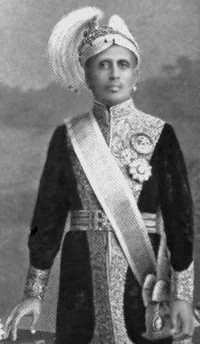
Maharaja Sri Mulam Tirunal
The 1900s were a time of great intellectual inquiry in Kerala. Maharaja Sri Mulam Tirunal increased state investment in education by 1500% and the population of Kottayam district neared 20,000: Academics associated with CMS college and individuals drawn by the growing publishing industry forming the basis for progressive political and cultural discourse.
The turn of the century also brought investigation of tradition and reexamination of long-held religious heritage. Alongside Hinduism and Islam, Kerala was home to an increasingly diverse Christianity, including Knanaya Christians with roots in Syria, Nazaranee Christians who traced their origins to first-century evangelism in India, Portuguese-Indian Catholics, and the Orthodox Malankara Christians who had thrown off Portuguese Jesuit domination in 1653. These evolved into numerous denominations, including the Jacobite Syrian Orthodox Church of our great-grandfather’s community in Puthupully, undergoing rumblings in the early 1900s that would lead to yet another split resulting in the Kerala Malankara Orthodox church. Protestant representation began during Dutch occupation in 1663 and grew in the following decades with the arrival of Western colonists and missionaries.
In 1905, A.J. Joseph, a 21-year-old Indian student from the Anglican community, began searching for a straightforward explanation of the Bible. He explored the teachings of the Adventists, a relatively new Protestant group, but remained disturbed by the Trinity doctrine and infant baptism, which seemed to have no biblical basis and struck him, rather, as pagan artifacts. Urged by his parents, he wrote to the head of the Adventists in India, asking for publications specifically explaining the Trinity. He received instead a volume of Studies in the Scriptures by Charles Taze Russell called “At-one-ment between God and Man”, which discouraged the concept of a Trinity altogether. Russell, founder of the fledgling International Bible Students Association, later called Jehovah’s Witnesses, essayed three separate entities, emphasizing the potential for a personal relationship with the Creator, use of his name—Jehovah, faith in the ransom paid by his son—Jesus, by means of his active force—or holy spirit.
A.J. Joseph sought further volumes of Studies in the Scriptures, requesting all of Russell’s publications from the Bible Students’ headquarters in the United States. He became a regular subscriber of Zion's Watchtower and Herald of Christ's Presence and even started distributing The Bible Students Monthly magazine to friends and relatives. By 1906, he was translating books into Malayalam and, joined by his father and cousin, traveling beyond Kottayam to share their learnings broadly, in large cities and into cumbersome, remote territories. The first bus services began in 1908 and aided the growing band of Bible Students in their efforts.
In 1912, Charles Taze Russell traveled to India and A.J. Joseph helped him give talks across Kerala. Russell spoke at Jubilee Town Hall in Trivandrum and nearby Nyarakad, where the impact of his message was so great that the village name was officially changed to Russellpuram, which remains its name to this day. The British Resident in Travancore invited Russell to stay at the residency and the Hindu Maharaja Sri Mulam Tirunal welcomed him into the royal palace, listening to his teachings respectfully and receiving six volumes of Studies in the Scriptures and a Bible. A.J. Joseph was energized by the visit, quitting his government job to become a full-time minister. He focused on translating publications and preaching extensively, even when this meant traveling inelegantly by bullock cart in the countryside. In famously literate Kerala, even simple people flocked to the opportunity to evaluate new ideas and expand their education.
A.J. Joseph gave public talks, distributing an associated book, The Divine Plan of the Ages, in predominantly Christian towns and settlements. Despite opposition from leaders of more historically established churches, the work progressed steadily and the study groups Joseph and his associates initiated in Kottayam, Aymanam, Chingavanam, Talapady, Meenadom, Ayerkunnam, Kanghazha, Valiyamala and Neermankuzhy developed into the first formal congregations of the International Bible Students in India.
In 1914, World War I broke out and communications between headquarters in the United States and the Indian congregations were disrupted. By 1918, governing body members of the International Bible Students Association were imprisoned under charges of sedition because they would not support war efforts, maintaining political neutrality. British authorities banned the activities of the Bible Students in India, confiscating their literature and deporting missionaries.
Despite the ban, membership continued to grow. The Bible Students in Kerala hid their remaining stock of publications, preaching informally and conducting meetings discreetly. From 1918-1920, they carefully continued their educational programs, using the Bible alone in public talks. K.C. Chacko attended one of these talks and became immediately convinced that he had found the spiritual truth he had been seeking. He abandoned his Jacobite studies and in 1920 became baptized as a Bible Student—a native son and gentleman of Puthupully choosing a form of worship that was illegal across most of the planet for its bold refusal of nationalism and the allegiances demanded especially at wartime, in moral alignment with Christ’s words: “You are no part of this world.”
In protest, his family and conservative religious community disowned him. Family opposition deprived K.C. Chacko only of their company (and maybe he was glad to be relieved of the endless social circuit of weddings and funerals); he was already in possession of his share of their inherited property and in an utter pinch could sell off land to support himself. He pursued faith with new energy, and once the ban was lifted, he joined A.J. Joseph as a full-time helper.
Their work was trailblazing and at times dangerous: Traditional Christians remained so opposed to the Bible Students that at one presentation, A.J. Joseph was dragged by his beard into a crowd of Roman Catholic, Syrian Christian, and Church of England devotees who joined forces to oppose him. Yet the team of five full-time ministers persisted: A.J. Joseph prepared lectures in Malayalam, K.M. Varghese, a schoolteacher, transcribed these for print publication, Mani, K.C. Oommen and K.C. Chacko traveled with them across Kerala, giving public talks, demonstrating Bible studies and distributing Bible study aids.
*
In an effort to deter him, on days when K.C. Chacko was planning to go out for theocratic activities, Penamma would wash all his clothes and hang them on the line sopping wet. But K.C. Chacko was gentle, kind, peaceable, and above all, patient. Eventually, his ferocious wife became even more zealous than he, and they raised their ten children as Jehovah’s Witnesses, the official name the Bible Students took on in 1931. Today, there are almost 60,000 Witnesses in India, and when we attend conventions we have relatives dotting the entire audience, and they delight to see us, pinching Mama’s cheeks and cuddling enormous Vinodmama as if he were still a rascally little boy.
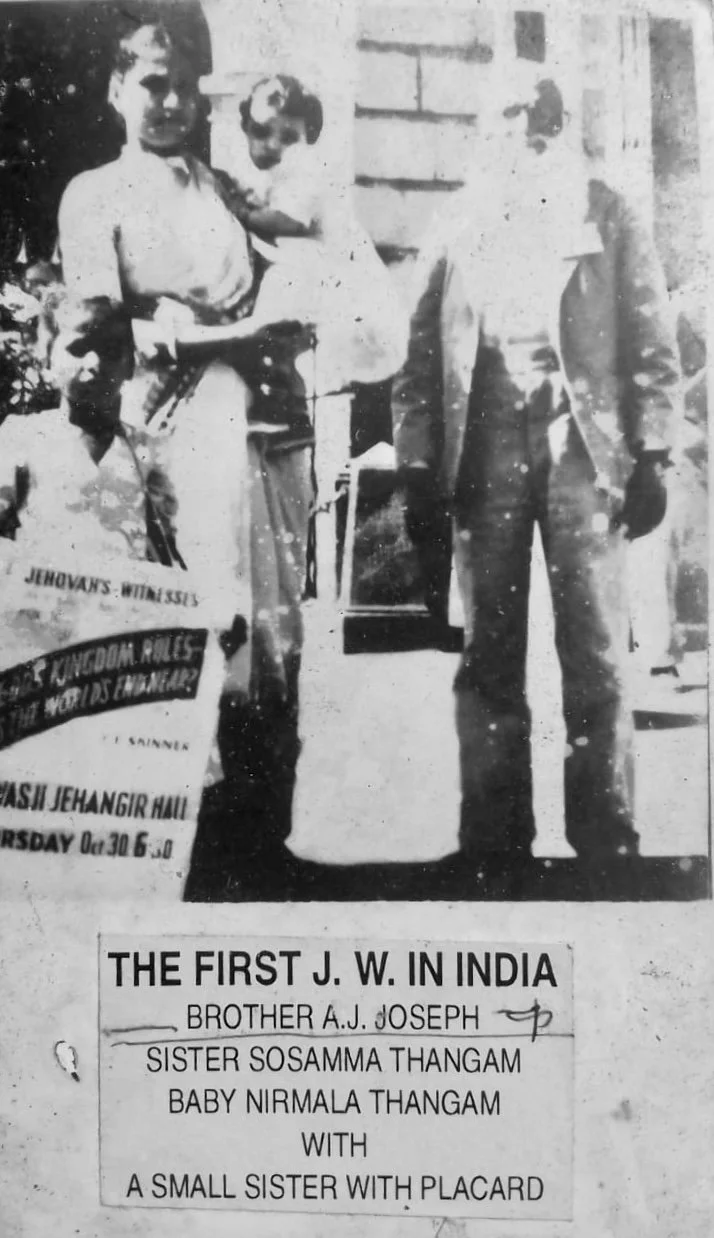
K.C. Chacko was a dreamer and forever supportive of callings of the heart. In the 1940s, he sent his eldest daughter to study for her BSC degree in Trivandrum, encouraged his adventurous daughters to preach in remote territories across India, even if they were unaccompanied by a husband, and approved Nani’s plan to become a flight attendant even though she had never traveled by plane; it now makes sense that Mama did not bat an eyelash when I said, at eight, that when I grow up I’d like to become a piano-playing, painting, ballet dancer—with her support, I did hit two out of three.
Mama grew up traveling from Bombay to visit her grandparents in Puthupully every year. Grandpop had bought land from K.C. Chacko and built Nirmala Nikethan as a summer home for the family. When Vinny and Mama went to stay there during her college years, her grandfather moved in with them and she remembers him as a simple man, even-tempered, even sweet, and hen-pecked by his wife. As an old man he was still tall and slender, dignified in his shirt and mundu, but by then balding and bent over, with an ever-present walking pole. He became Mama’s confidant and knew all about her secret correspondence with Papa, who had moved to America: He would wait for the postman during the day while Mama was in class and save Papa’s letters under his pillow to give her when Vinny wasn’t around (because her big little brother was overprotective and would ruin it all). When Mama returned from school, her grandfather would appear with the latest letter and say, innocently, “Kunj, come here?”
K.C. Chacko gently broke news of the correspondence to Nani, and while she was contemplating whether to interfere, doubting the long-distance relationship and the sincerity of a newly converted man, he consoled and counseled her: “Let her be, let her marry him, otherwise she will go mad.” There was indeed a certain delicacy in the family and so Nani had to concede.
His final purpose fulfilled, K.C. Chacko passed away in April 1979, two months before the wedding.
Further Reading
“India” Yearbook of Jehovah’s Witnesses, 1977.