
Michelle Sindha Thomas
IN THE BEGINNING
INDIA 1750 BC–1900 AD
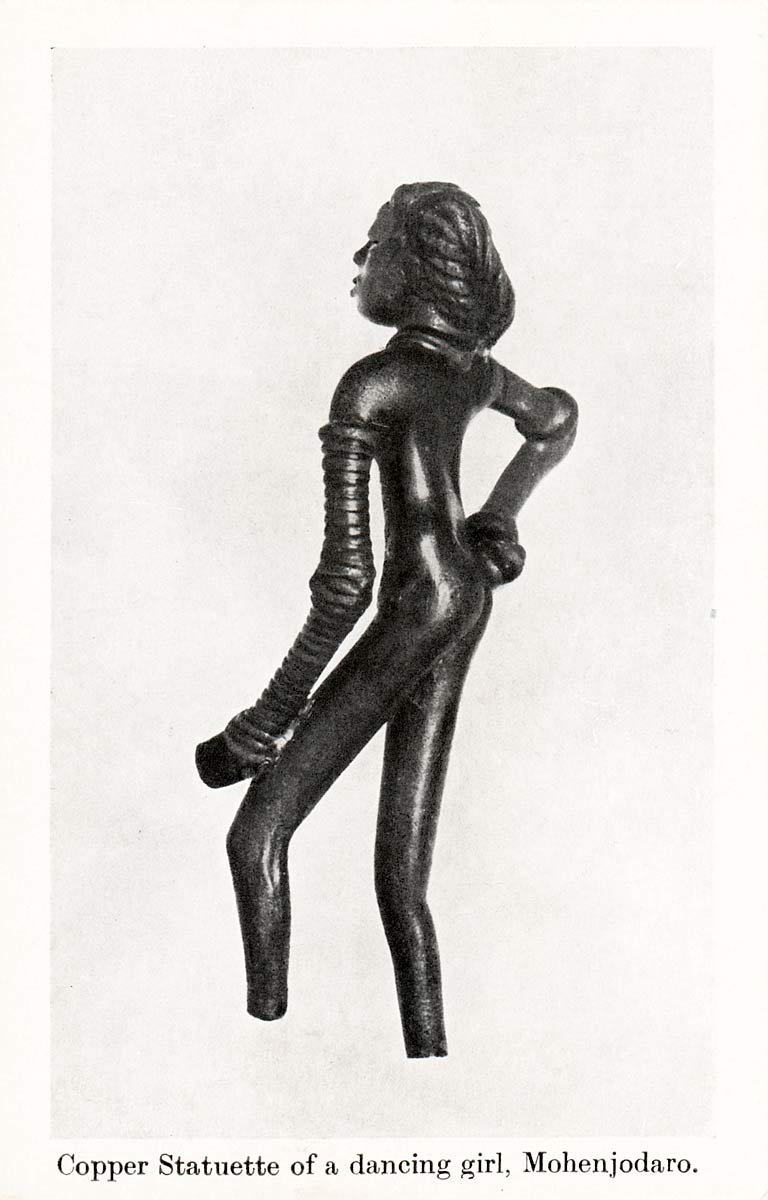
Excavations in the region of the Indus civilization unearthed thousands of seals engraved with bulls, bison, rhinos, crocodiles, elephants, mythical animals, and possible deities including a three-headed figure considered a progenitor of the Hindu god Shiva. Bronze and terracotta female figures, such as the iconic Dancing Girl of Mohenjodaro with her sassy stance and exaggerated pout, suggest female veneration or at least adoration.
A polytheistic religion of the Indus civilization with key beliefs, figures, sacred narratives, and practices traced to ancient Babylon evolved to become a new religion native to the subcontinent, shaped by waves of migration by Central Asian nomadic tribes before invasions by Persian, Greek, and Scythian forces. The Dravidian language originating in the Indus River Valley migrated south to become over time a family of languages including Tamil, Telugu, Kannada, and Malayalam. In the north, a language with relation to ancient Greek and Latin developed upon encounter with languages of the subcontinent to become Sanskrit. Its origin can be traced to a Proto-Indo-European language which includes hundreds of ever-evolving languages and dialects (including Persian, Pashto, Kurdish, Portuguese, Spanish, French, English, German, Russian). As Latin is the parent of Romance languages, Sanskrit has modern descendants including Hindi, Urdu, Bengali, Punjabi, Marathi, Kashmiri, with traces present in the languages of South India and even farther beyond in Thailand and the Philippines. Sanskrit is preserved as a language of ceremony and tradition, a cultural treasure containing abstract nouns and philosophical expressions not present in other languages, a descriptive vocabulary including, for example, 250 words for rainfall and 67 words for water.
Around 500 BC, the scholar Daksiputra Panini standardized and formalized Sanskrit grammar in a linguistic analysis called Astadhyayi. The text of eight chapters documents and explains 4,000 rules, citing their sources in the scholarship of previous linguists and grammarians. Panini’s systematic method and scientific theory of grammar, predating any Western equivalent by millenia, marks the start of Classical Sanskrit, establishing it as the preeminent Indian language of erudition, literature, high culture, and religion for the following two thousand years.
The oldest examples of Sanskrit literature are the Vedas: initially composed, memorized with support from complex mnemonic devices, and preserved orally over centuries, until they were finally documented in Sanskrit and circulated beginning in the fifth century BC. The Rigveda, Yajurveda, Samaveda, and Atharvaveda were sacred texts of the Vedic religion practiced by the Indo-Aryans, tribal migrants of Southern Europe and Central Asia who began to settle in the northwest of the Indian subcontinent. They established the Kuru kingdom, reigning from 1200-525 BC. Their worship was of the same origin and tradition as the ancient Persians, Greeks, Romans, and Germanic people: The Vedic god Dyaus is a variant of the Proto-Indo-European god Dyeus—from which also issued the Greek Zeus and Roman Jupiter. The Vedic Manu and Yama derive from the Proto-Indo-European Manu and Yemo—from which also issue the Germanic Mannus and Ymir. The Vedas, revered as divine in origin, contained moral instruction that aided kings in maintaining social order, with a priestly class called Brahmins taking the lead in performing rites and rituals that emphasized the status of the king while introducing neighboring communities into both Vedic practice and the Sanskrit language of the sacred texts. Even after the Kuru kingdom gave way to regional governance, the Vedic belief system and associated traditions spread across the subcontinent, synthesising with local belief systems, absorbing local deities, narratives, and traditions.
The years from 538-325 BC brought disruption to the subcontinent with conquest by Cyrus the Great and control transferring from Darius I-III of Persia to Alexander, who retreated only after a devastating battle with King Porus of Punjab and his army of war-elephants, followed by reports of the Nanda army he would encounter beyond the Ganges River: Five times the size of his own, according to Plutarch, “with 80,000 horsemen, 200,000 footmen, 8,000 chariots, and 6,000 fighting elephants.”
In 321 BC, Chandragupta Maurya founded what would become the Mauryan Empire, defeating both the fearsome Nanda dynasty and the vestiges of Alexander’s Seleucid Empire. While the first rulers of the Mauryan dynasty promoted Vedic religion, maintaining the Brahmins as royal advisors, new forms of worship came to the fore: Jainism dominated the northeast and in 268 BC, Asoka, regarded as the greatest ancient Indian emperor, took the throne, championing Buddhism during his reign. While he started out as an aggressive young warrior, he experienced remorse after a particularly bloody conquest at the kingdom of Kalinga and found reprieve in the teachings of Buddha. He promoted Buddhism across the Mauryan Empire which, under his leadership, came to include most of South Asia, while sponsoring preaching even farther beyond, to the southern tip of the subcontinent, even as far as Sri Lanka and Southeast Asia. Asoka incorporated Buddhist principles into his law code, advocating for egalitarianism, religious tolerance, animal rights, and general non-violence.
By 200 BC, the failure of Asoka’s successors ensued in a period of relentless northern invasion from Greeks and various Central Asian peoples, with many settling in the subcontinent. Regional powers coexisted, governing within natural geographical boundaries with no dominant empire establishing widespread control. A diversity of philosophies flourished across the subcontinent as foreign exposure and trade surged, with the Brahmins expounding upon the Vedas and epic sacred texts along trade routes and—learned, diplomatic, elite, and multilingual—on royal delegation to far-flung communities.
For over two thousand years to follow, Vedic belief systems brought a measure of cultural continuity to societies from the north of the Indian subcontinent to the southern tip. By the first century AD, an utterly Indian worship system had emerged, formalized, established, and recognized as Hinduism, the mainstream institutional religion, generally practiced peaceably alongside Jainism, Buddhism, and the Judaism brought by settlers living near trading centers. The Chera dynasties of the southwest coast earned renown for success in foreign trade and collaboration with Chinese, West Asian, Greek, and Roman merchants. Historical registers document trade at the port of Muzhiris including gold, silver, gems, ivory, perfumes, liquor, fish, rice, pepper, and other spices. Foreign interchange and the presence of diverse settlements brought particular nuance to the cuisine, games, architecture, language, and belief systems available in Kerala from ancient times—the first Jewish settlers are believed to have arrived around 1030 BC in the days of King Solomon.
While Hinduism was spreading across India, Judaism was borne from one family in West Asia and, by the 15th century BC, developed into a monotheistic Hebrew community with a culture distinct from the mainstream African society surrounding them. According to Jewish chronology, acknowledged by Christian and Muslim tradition, a man named Abraham living in ancient Mesopotamia was known for such great integrity that God himself declared him righteous and called him a friend. He promised Abraham that he would bring a great blessing to mankind by means of a messiah born into Abraham’s family line.
Over time, God revealed the nature of the blessing: The messiah would win back what the first man, Adam, had lost. Adam had decided to pursue a course of independence for himself and his descendants, refusing his creator’s oversight and care. Mankind, therefore, incapable of governing themselves well, tumbled along in a constant flux of trial and error, roiling in chaos, war, and suffering on a grand scale. By means of prophets, God urged those who yearned for better governance to call upon him for support, to use his personal name, Jehovah, in prayer, and to have faith that he would soon intervene to restore theocracy and his original purpose for peaceful life on earth.
Abraham’s grandson, Jacob, and his family lived in locations across Syria and northern Africa. Jacob’s son, Joseph, brought the family to live in Egypt to help them survive a great famine. The family settled in Egypt but as they multiplied over the course of a few hundred years, they went from welcome guests to become an oppressed, enslaved ethnic group.
The Hebrew-speaking descendents of Abraham were eventually led out of slavery by the divinely appointed patriarch Moses. A series of plagues inspired what the scriptures call a “large mixed crowd” of Africans and other settlers in Egypt to join the Hebrews in their faith and their dramatic exodus from Egypt. Their belief system and religious practice was formalized in the Mosaic Law, inspired by God and delivered by Moses, which contained moral instruction, a legal code, and an extensive list of precautions and instructions for hygiene that would protect them from diseases which extinguished contemporaneous ancient societies. God continued to communicate with them by means of prophets, urging them to anticipate a messiah, his very own son, who would lead all of mankind to a deliverance greater than their release from Egypt. Over hundreds of years, the plan began to unfold: The location, circumstances, and approximate year of the Messiah’s birth were revealed by means of prophecies and documented in the Hebrew scriptures.
By the time of Jesus' birth, the Jews were subject to Roman rule. Parochial folk assumed the promised messiah would become involved in national politics to combat Rome. When Jesus began teaching by means of metaphor and preaching what seemed like abstractions, many were affronted and opposed him. He proposed a radical departure from the culture of Judaism, by this point established for centuries. Now that he had arrived, winning back what Adam had refused, those desiring a relationship with their creator no longer needed the intermediary of a priestly class. Jesus taught that his sacrifice would serve as a ransom for what Adam had lost, providing mankind with the opportunity for an approved standing with God. They would no longer need to offer sacrifices to atone for their sins; these were only ever intended as a symbol for the perfect sacrifice he would provide. His deliverance was intended to be applied expansively, not only for Jewish people of the day seeking freedom from Rome. He preached a future of peace and freedom from suffering for all people. God’s original promise to Abraham had meant that all mankind would be delivered by means of his family line, and that they would have the privilege to hear and accept the plan for deliverance first.
Christianity was named after Jesus Christ, meaning anointed one, or messiah. His first followers were Jews and people from surrounding areas who had various forms of worship which also anticipated a savior who would “explain everything to us,” said the Samaritan woman at the well, straightforwardly. Jesus greatly simplified the Mosaic Law in favor of a few universal principles, leaving his followers with a commission to share his teachings beyond Jewish borders: He would face an earthly death in order to fulfill prophecy and provide the ransom before rejoining his father in heaven, but promised to support their efforts and to return soon: “Go therefore and make disciples of people of all the nations,” he said, “teaching them to observe all the things I have commanded you. And look! I am with you all the days until the conclusion of the system of things.” He provided them with signs of his return and the end of the current world order, including false prophets, nations warring, food shortages, earthquakes, persecution of the honesthearted, lawlessness, lovelessness. “But the one who has endured to the end will be saved,” he reassured them, “And this good news of the kingdom will be preached in all the inhabited earth for a witness to all the nations, and then the end will come.”
Jesus’ immediate apostles led the charge, an ordinary group from fishermen to a tax collector, rendered extraordinary by their mission: Peter, Andrew, James, John, Philip, Bartholomew, Matthew, James, Thaddaeus, Simon, and Thomas.
Legend has it that in 52 AD the apostle Thomas himself traveled to preach to Jews and Jewish proselytes settled in India. In reality, it could have been any number of early disciples; contact with points across the Roman world and India was regular, with logs documenting around 200 specifically Roman merchant ships reaching India each year until the fall of the empire, when the sea route was intercepted by Arab traders. Thomas visited Jewish settlements, preaching in colonies along the coast and Periyar River tributaries until his death in 72 AD. South Indian Christians who date their faith to this time maintain oral histories and customs that reflect the particular Hebrew Christianity he would have taught, obeying Jewish food laws, performing circumcision, observing Passover. In remote areas that were insulated from later generations of missionaries, services are still conducted in Aramaic, the language Thomas and early disciples of Jesus would have spoken. Beginning in 200 AD, Christian settlers from Syria arrived, led by Knai Thoma, a merchant who brought 72 families to the Malabar Coast. Persian settlers and missionaries followed, and by 900 AD they comprised a powerful merchant community.
Despite periods of conflict and battle with intervals of peace across north India, the Hindu kingdoms of the Malabar Coast had a long-standing record of pragmatism, cooperation, even collaboration with Arab traders who took over Roman sea-trade routes; a record of benevolence, granting Jewish refugees and Christian settlers protection and their own lands to manage—a harmonious secularism across caste and creed. When Islam arose in West Asia, Muslim missionaries arrived in Kerala on Arab merchant ships and succeeded in sharing their faith and culture, with many Arabic terms integrating with Malayalam, especially religious salutations and business terms including the words for document, contract, and balance. By 1192 AD, the Ghurid dynasty introduced Muslim rule in the north, expanding their presence from present-day Afghanistan to Bengal by 1202, evolving into the Delhi Sultanate. In Kerala, port towns became host to growing Muslim trading communities, with the support of local Zamorin rulers who grew exceedingly wealthy from the collaboration.
When Marco Polo, an Italian-born emissary of Kublai Khan, encountered southern India in the 1250s, he observed the unaffected coexistence of Hindus, Jews, Christians, and Muslims, visibly differentiated by their customs, clothing, adornments, and styles of grooming. The port of Calicut rose to such prominence by the time of the 14th century visit of Ibn Battuta, an African Muslim official of the Delhi Sultanate, that it was one of the most prosperous towns on the west coast of India, with a fleet of everpresent Chinese junks at its pier and the presence of a diversity of merchants from across Asia. He compared Calicut and the port city of Quilon to Alexandria, replete with formal schools, temples, mosques, gardens, orchards, and elegant markets brimming with soft fabrics, precious metals and gems, sugarcane, bamboo, pepper, and ginger.
The Mughal Empire was established across northern India in the 1500s, ushering in a period of unprecedented material prosperity and cultural abundance. Mughal emperors were great patrons of the arts, known for religious tolerance and cosmopolitanism, though the general impact of their reign is disputed. Buddhism sharply declined while tensions arose between Muslim and Hindu parties; some from pre-Islamic religions sincerely aligned with the belief system offered by Islam, some likely coerced, while others converted for various social and practical benefits.
The writings of Ibn Battuta and Marco Polo circulated widely over time, igniting a new curiosity about South Asia, which had been inaccessible to Europe for 1,000 years—since the fall of Rome.
In 1498 Portuguese explorers led by Vasco da Gama arrived in pursuit of trade, but also in search of the Indian Christians that Marco Polo described, certain of their support in the European Crusades. They landed on the Malabar Coast and were met with indifference. The Christians of Kerala were relatively secular and generally integrated within a society that was more broad-minded and sophisticated than Europe of the time. The locals were not interested in the rough-and-tumble Portuguese visitors with nothing to lose and everything to gain, remaining dismissive of their diplomatic efforts and unimpressed by the trinkets they brought along to sell.
Portuguese reinforcements began to arrive and by 1503 the kingdom of Cochin was overtaken, creating the first European settlement in India. They employed piracy and violence to make headway in trade on the Arabian Sea and began to attack the Christians, who claimed a native tradition established prior to the Roman Catholicism of the Portuguese and had never even heard of the Pope, let alone acknowledging him as the father of their faith. Portuguese settlers including religious migrants continued to arrive into the 1500s, and they persecuted the native Christians, seizing their assets and declaring them heretics. When initial efforts to compel them to accept Catholicism and denounce local rites failed, Portuguese Jesuits forced conversion on threat of death, destroying the documentation of the native Christians and burning their historical records as part of a systematic inquisition that spanned the coast from Goa to Cochin. By 1599, the Synod of Diamper Latinized the native Christians’ East Syriac Rite, replacing their tradition with Latin vestments, rituals, and customs, formally bringing all Indian churches under the jurisdiction of the Roman Catholic Church.
The Orthodox Malankara Christians, a group of native Christians in Kerala, resisted this decision, separating themselves from the churches of India now rendered Catholic and subject to the Pope in Rome. They aligned themselves with the Patriarch of Antioch and, at a meeting in Mattancherry in 1653, resolved to defy the Portuguese oppressors, designating a local Indian bishop. They disowned the Roman Rite, reinstating services in their mother tongue of Malayalam and reviving suppressed traditions.
Kerala was by now home to diverse streams of Christian tradition: In addition to the Knanaya Christians who traced their roots to Syria and Nazaranee Christians who traced their worship to first century evangelism in India, a Portuguese-Indian Catholic population had been growing for 150 years. Christians in opposition to foreign religious domination now had the opportunity to decide whether to practice Portuguese-instituted Roman Catholicism or to join the newly formed Malankara Church of Kerala.
Out of a population of 200,000 native Christians in Kerala, only 400 remained loyal to the Portuguese archbishop, breaking the 54-year Portuguese Catholic dominion formalized at the Synod of Diamper.
The faction loyal to the Roman Catholic church evolved into the modern Syro-Malabar Church and Chaldean Syrian Church, while those opposed to Jesuit domination folded into denominations including the Malankara Mar Thoma Syrian Church, the Malankara Orthodox Syrian Church, the Syro-Malankara Catholic Church, and Jacobite Syrian Christian Church.
In 1663 the Kerala kingdom of Cochin was conquered by Dutch forces who ordered all Portuguese Catholic missionaries to leave—inevitably replacing them with Protestant missionaries and bringing ever-increasing diversity to Christianity in Kerala. They were followed by British occupation and droves of associated northern European and American missionaries who busied themselves with public engagement, building meeting halls and schools. While Papa’s family is Catholic, he went to a CSI Protestant grade school and college. Mama’s family includes Jacobite Syrian Christians and Jehovah’s Witnesses. We are children of Kerala, of a minority religion and culture in the grand scheme of things, but our very specific heritage is influenced by a dizzying multiplicity: Arabs, Africans, Persians, Syrians, Chinese, Portuguese, Dutch, British, Hindus, Jews, Buddhists, Christians, Muslims, ambassadors, pirates, voyagers, visitors cum colonizers, missionaries, atheists, communists, hippies, offshoots and combinations of all of the above.
*
I know you find it ridiculous that I’ve taken a DNA test but I’d been confused by our childhood in the Midwest, all the people who wanted me to be Mexican, Moroccan, Venezuelan, Guyanese, Hawaiian, Filipina, Tongan, Tunisian, of any equatorially-adjacent nation except India because, unlike Mindy, a short Indian, or Padma, a tall Indian, I have smiley almond eyes and fluffy hair which, for them, just do not compute. They suppose I’m the love child of ebony/ivory parents: “You can’t be Indian and you have to be at least half white,” insisted Scott Sincavitch, scratching swastikas into his skateboard with a compass tip, while our cousin’s grandmother openly wondered why I have “hair like a Negro.” She herself claimed Syrian heritage (famously tight curls + frizz) so I found her confusion puzzling—in that if my hair is not silky then I must be African, but I suppose the ‘70s style revolution never reached her neck of the woods, that glorious time when modern modern ladies liberated their hair from the plait and men puffed out their curls to unprecedented heights.
The first test said my DNA matched that of people from the general subcontinent including India, Pakistan, Bangladesh and Sri Lanka. Every subsequent update narrows down the geography, first to western India, then to the southwest, now a specific slice of the Malabar Coast, making it clear that from Papa with his afro to Nani with her three wisps of hair, we are actually pure Indian phenotypes. Our almond eyes are not Chinese. Our height is not Dutch. Our curls are not Portuguese.
On both sides of our family, for the dozens of generations and thousands of years accounted for in modern DNA testing, regardless of the many waves of peoples crashing into India and Indian Christian culture, we are 100% not simply of India but of Kerala, of the district of Kottayam, and much of our story takes place specifically in the sleepy town of Puthuppally, meaning “new church.” We are not the exotic birds they think we are (I thought we were), Indian! Christian! Artists! Teachers! Maybe we are exotic, but only in our extreme specificity. We are exactly what we were born to become. We are the most unsurprising, to-be-expected children of a church town in a district known for education, literature, and the arts.
Further Reading
“India Has a Long History of Native Christianity” The New York Times, Sudha Trivedi, 22 Feb 1986.
The Argumentative Indian: Writings on Indian Culture, History and Identity by Amartya Sen, 2005.
Ancient Indian Costume by Roshen Alkazi, 1996.
“From 1599 to today: Tracing Kerala’s Jacobite vs Orthodox church battle” The News Minute, Haritha John, 08 Aug 2017.
Hassan J., Manu T., Sukesh Kumaradas, AK Ampotti, 2020. Arab Accounts of Malabar History: The Early Episodes. Heritage: Journal of Multidisciplinary Studies in Archaeology 8.1: 791-810.